Well folks, it's Sunday, and I thought I would celebrate my not being compelled to go somewhere and babble to the sky god of the Christians, by having a few beers, and attacking one of their most sacred premises: the myth that the United States was founded on "Judeo-Christian" values.
According to this myth, the intention of the 'Founding Fathers' was to establish a nation on North America whose morals, laws, civil codes, etc. were based on some unified set of beliefs codified by some (non-existent) amalgamated system of Jewish/Christian belief. There are so many things wrong with this idea that I hardly know where to start.
Before I begin, let me start with my qualifications for a redress of this issue. I have a hard won (and much paid for) BA in American history, and am six hours short of an MA in the same subject (which is where my tendencies of over detailing and over citing my posts come from). I also have a lifetime of experience with supposed Christian values, and an extensive amount of time studying the Bible. While none of this makes me some kind of top-dog scholar in this area, it is far more expertise and qualification in this subject than 99.9% of the people who spout the nonsense to begin with.
First, let's look at the term
Judeo-Christian Values. Simply put: there is no such thing. The term itself, according to the
Oxford English Dictionary, was first used in 1899 (well after the founding), but in relation to the separation of Jewish and Christian beliefs. The first usage of the term in its modern context wasn't until 1938 as an alternative the term 'Christian civilization' in light of Hitler's attacks on Judaism: basically a political move by what would become the Allies to not be seen as anti-Semitic.
As for some actual set of Judeo-Christian beliefs, no such thing exists. Simply put, Christianity, under Jewish law, is a large heresy, and vice-versa. While their are beliefs common to both sides: the Ten Commandments, the Patriarchs, God..., the very basis of Christianity (i.e. Jesus as God) puts all Christians in violation of the first commandment 'there is only one god, and God is it.' The majority view under Jewish law is that Christians and Jews do not worship the same god.
So, Judeo-Christian values cannot actually exist. But, when Christians use the term they don't mean to include Judaism anyway, they are more accurately meaning:
Christian values some of which are based on select Jewish values, but only those which we agree with.
Otherwise, no Christian would eat pork and the inquisitions would have never happened.
So, these idiots actually maintain that the United States was founded on Christian values, and never intended for there to be a separation of religion from government. Which, is another assertion based on ignorance and mythology.

Now there needs to be a clarification of the term
the United States was founded. Technically the United States was founded in 1781 with the ratification of the
Articles of Confederation, but was not an actual sovereign state until the
Treaty of Paris in 1783. In fact the Articles of Confederation were considered to be a
temporary system under which the original colonies could have a system of government during the ongoing war with England. The United States government as it stands now began on 1789 with the ratification of the
US Constitution.
None of these documents call for a place in government, and one, the Constitution, actually forbids such a union twice:
First in Article VI when it expressly forbids religious belief being a prerequisite for government office:
The Senators and Representatives before mentioned, and the Members of the several State Legislatures, and all executive and judicial Officers, both of the United States and of the several States, shall be bound by Oath or Affirmation, to support this Constitution; but no religious Test shall ever be required as a Qualification to any Office or public Trust under the United States.
Then again in the oft' misquoted, and extremely misread First Amendment (section in bold commonly forgotten by religious folk):
Congress shall make no law respecting an establishment of religion, or prohibiting the free exercise thereof; or abridging the freedom of speech, or of the press; or the right of the people peaceably to assemble, and to petition the Government for a redress of grievances.
Side Note: An Amendment that is often overlooked by those in this country who want religion to be part of government is the Ninth Amendment, which forbids the adoption of any amendment which contradicts the first ten. Basically meaning that Congress cannot just make an amendment in violation of the first ten such as an amendment requiring or allowing a union of religion and government.
For sensible literate people these documents are proof that Jefferson, Madison, Franklin, etc. were against a melding of religion (including Christianity) and government. But, there are the stubborn who say something to the effect that we are reading all of this wrong--that the founding fathers believed in a Christian government and we have perverted their intentions. Statements to this effect are not only stupid, but can be proven wrong with the words of the founding fathers themselves.

First up we have Thomas Jefferson, author of The Declaration of Independence, and the
Virginia Statute for Religious Freedom.For some people, the "inalienable rights" line in the Declaration is proof of Jefferson's intention to have a Christian government, which is another example of misread and misquote.
Here is the line:
We hold these truths to be self-evident, that all men are created equal, that they are endowed, by their Creator, with certain unalienable Rights, that among these are Life, Liberty, and the pursuit of Happiness.
Pay special attention to the two words
their creator. Notice that it does not say "our" creator, or "the" creator. This entity could be, the Egyptian creator, the Sumerian creator, Vishnu, basically any creator whom the person mentioned believes in.
Yes, Jefferson believed in the Christian god, but not in the way most Christians today do, and Jefferson held a firm belief that this, or any, god had no place in government, which he quite eloquently states in the Virginia Statute for Religious Freedom:
Section 2: "...no man shall be compelled to frequent or support any religious worship, place, or ministry whatsoever, nor shall be enforced, restrained, molested, or burthened in his body or goods, nor shall otherwise suffer, on account of his religious opinions or belief; but that all men shall be free to profess, and by argument to maintain, their opinions in matters of religion, and that the same shall in no wise diminish, enlarge, or affect their civil capacities."
Section 3: "...that the rights hereby asserted are of the natural rights of mankind, and that if any act shall be hereafter passed to repeal the present or to narrow its operation, such act will be an infringement of natural right."
Jefferson wrote this, and Madison championed it. The two men combined forces again when they got the Establishment Clause codified into the Bill of Rights.
Jefferson was so proud of this statute that he requested that it be considered one of his three greatest accomplishments along with the establishment of the University of Virginia, and the Declaration of Independence.
But, I have heard the argument made that these documents were edited, amended, or otherwise changed and therefore do not actually represent the personal ideology of Jefferson and Madison--Wrong again.
In a letter to the Danbury Baptists written in 1802, Jefferson said the following concerning the First Amendment:
Believing with you that religion is a matter which lies solely between Man & his God, that he owes account to none other for his faith or his worship, that the legitimate powers of government reach actions only, & not opinions, I contemplate with sovereign reverence that act of the whole American people which declared that their legislature should "make no law respecting an establishment of religion, or prohibiting the free exercise thereof," thus building a wall of separation between Church & State. Adhering to this expression of the supreme will of the nation in behalf of the rights of conscience, I shall see with sincere satisfaction the progress of those sentiments which tend to restore to man all his natural rights, convinced he has no natural right in opposition to his social duties.
From this we get Jefferson's rationale for the Separation Clause. His obvious and stated intention was to build a "wall of separation" between government and religion so that a perceived set of religious rights could not interfere with governmental duties. This letter was a show of solidarity with the Baptists who had written him a letter regarding their fears that a majority religion could gain control of the government. They felt that such a thing was unacceptable because "Religion is at all times and places a matter between God and individuals... no man ought to suffer in name, person, or effects on account of his religious Opinions." Something of a slap in the face of current Baptists who believe differently.

This opinion was echoed by James Madison in a letter he wrote to the Baptist churches in 1811. In this letter, Madison says that:
"practical distinction between Religion and Civil Government is essential to the purity of both, and as guaranteed by the Constitution of the United States"
Eight years later in a letter to Robert Walsh, Madison reaffirmed this belief when he said that there was a:
"total separation of the church from the state"
Which, according to Madison, was:
"Strongly guarded . . . is the separation between religion and government in the Constitution of the United States,"... .
For anyone who thinks the above statements from Madison, or Jefferson are out of context, the Library of Congress has them online, and you are welcome to do some of your own research.
Madison and Jefferson were by no means the only Founding Fathers to have reservations about religion.
In 1776, in his pamphlet, Common Sense, Thomas Paine wrote:
"As to religion, I hold it to be the indispensable duty of all government, to protect all conscientious professors thereof, and I know of no other business which government hath to do therewith…"
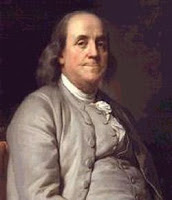
And there's my favorite letter on religion, written by Benjamin Franklin to Richard Price a "friend or Quaker" in 1780:
I am fully of your opinion respecting religious tests; but, though the people of Massachusetts have not in their new Constitution kept quite clear of them, yet, if we consider what that people were 100 years ago, we must allow they have gone great lengths in liberality of sentiment on religious subjects; and we may hope for greater degrees of perfection, when their constitution, some years hence, shall be revised. If Christian preachers had continued to teach as Christ and his Apostles did, without salaries, and as the Quakers now do, I imagine tests would never have existed; for I think they were invented, not so much to secure religion itself, as the emoluments of it. When a religion is good, I conceive that it will support itself; and, when it cannot support itself, and God does not take care to support, so that its professors are obliged to call for the help of the civil power, it is a sign, I apprehend, of its being a bad one.
Not only does Franklin believe government and religion should be separate, but he believed that getting paid to preach was wrong, and that a religion that had to get help from a government was not sanctioned by God.
Amen Benny--Amen.
Technorati Tags:
church and state judeo-christian jefferson
 There's an important case coming before the US Supreme Court next week brought by Annie Laurie Gaylor of the Freedom From Religion Foundation (FFRF). Gaylor will argue that President Bush's Faith Based Initiatives is a government promotion of religion and therefore unconstitutional.